
All-on-6 vs All-on-4: Differences to Discuss With Your Dentist
Thinking about a fixed full-arch bridge? Here is a clear look at All-on-6 vs All-on-4: how the two approaches differ, what affects suitability, and the questions to bring to your dental consultation.
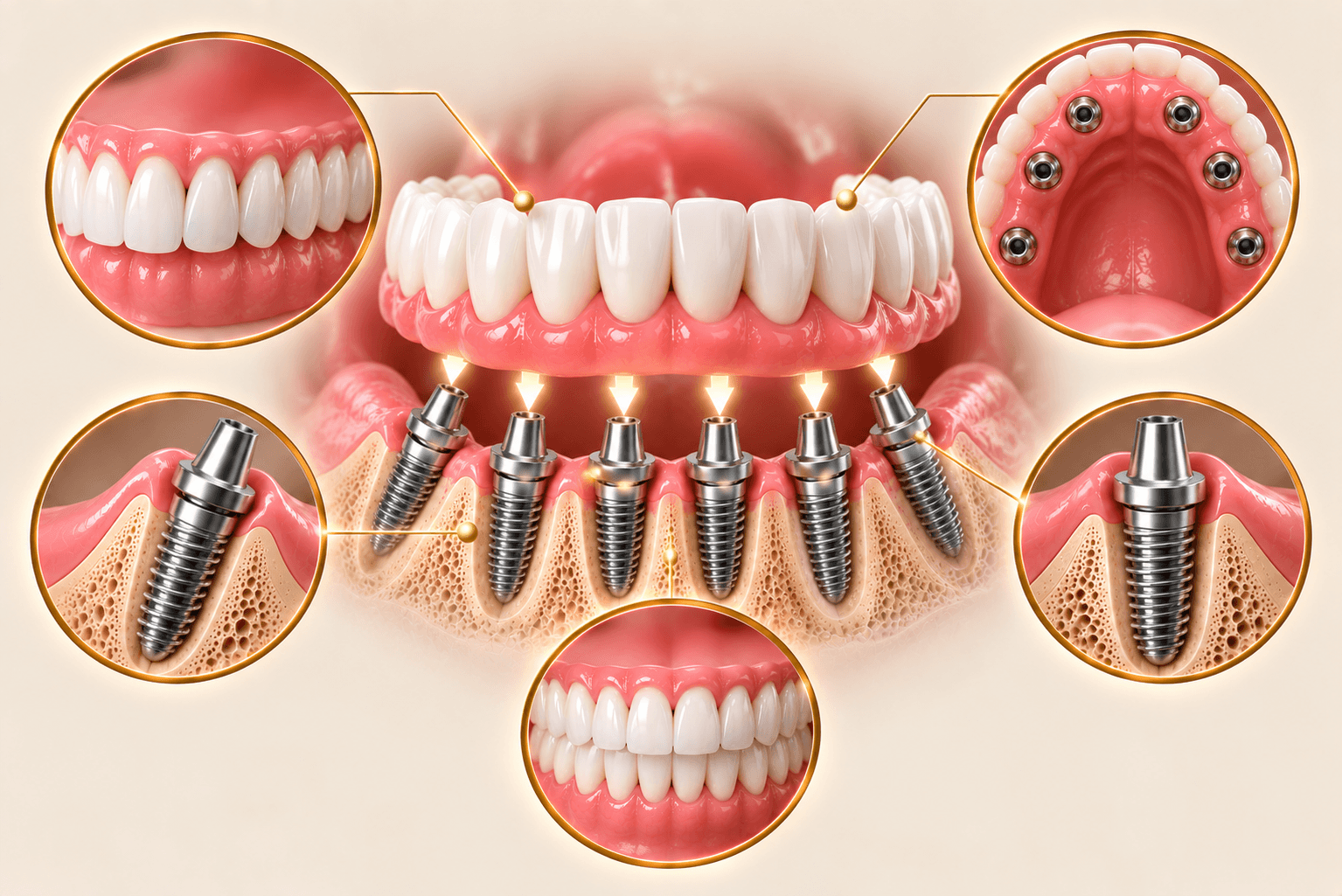
If you have lost most of your teeth in one jaw, or your remaining teeth can no longer be saved, you may have come across two similar-sounding options: All-on-4 and All-on-6. Both aim to give you a fixed set of teeth instead of a removable denture. Comparing all-on-6 vs all-on-4 can feel confusing at first, so this guide explains the main differences in plain language. It also lists the questions worth asking, so you can have a well-informed conversation with your dentist or oral surgeon.
Please keep in mind that this article is general information. Only a dentist who has examined you and reviewed your scans can say which approach suits you.
What All-on-6 and All-on-4 have in common
Both treatments replace a full upper or lower arch of missing, badly damaged or failing teeth with a fixed bridge. The bridge is screwed onto implants placed in the jawbone, so you don't take it out at home like a conventional denture.
The two approaches share several features:
- They are used for people who have lost most or all of the teeth in one jaw, or who want to replace an uncomfortable removable denture
- Treatment usually happens in stages, often with a temporary bridge first and a final bridge later
- They are normally done as an outpatient procedure under local anaesthesia, sometimes combined with sedation or, in some cases, general anaesthesia
- Healing includes a first phase with swelling and a soft diet, then a longer phase while the implants bond with the bone
- They need daily cleaning, including under the bridge, plus regular professional check-ups
All-on-6 vs All-on-4: the main difference
The most obvious difference is the number of implants supporting the bridge. With All-on-4, four implants hold the full-arch bridge. In many All-on-4 plans, the two back implants are placed at an angle so they can use the available bone. With All-on-6, six implants are placed in the jaw and the bridge is attached to all of them.
Spreading the chewing load across six implants can give the bridge extra support. That does not automatically make one option better than the other. Each one is designed for different situations, and the right choice depends on your jaw, your health and your dentist's assessment.
Points often discussed when comparing the two:
- Support and load distribution: more implants means the bite force is shared across more points
- Bone requirements: placing six implants generally needs enough suitable bone in more areas of the jaw
- Angled implants: four-implant plans often use angled implants, which may help some people with limited bone
- Surgical scope: more implants can mean a more extensive procedure, which your dentist should explain
- Cost: the number of implants is one of several factors that can affect the price
How your jawbone affects the choice
Bone is often the deciding factor. Before planning either treatment, your dentist will usually take X-rays and a 3D scan (CBCT). These show how much bone you have, how good it is, and where nerves and sinuses sit.
If there is enough bone in the right places, six implants may be an option. If bone is limited, your dentist may suggest fewer or angled implants, a bone graft, or in some cases zygomatic implants, which are anchored in the cheekbone. Bone loss tends to increase after teeth have been missing for a long time, so the scan results may differ quite a lot from one person to the next.
Other factors your dentist will consider
Bone isn't the only thing your dentist looks at. Suitability for either all-on approach also depends on:
- Gum health and any active infection
- General health conditions, such as diabetes or conditions that affect healing
- Medications, especially those that affect bone or blood clotting
- Smoking, which can affect healing and implant stability
- Whether one or both jaws need treatment
- Your expectations and how easily you can keep up with daily oral hygiene
Be open about your medical history and habits. This helps your dentist recommend an approach that is realistic and safe for you.
Recovery and risks with All-on-4 and All-on-6
Recovery is broadly similar for both options, but it differs from person to person. In the first days, swelling, tenderness and possibly bruising are common. You will usually start on a soft or liquid diet and slowly return to firmer foods when your dentist says so. Cold compresses, pain relief as directed, careful cleaning and avoiding smoking and alcohol are usually part of the aftercare.
Like any surgery, both treatments carry risks. These can include:
- Bleeding or infection
- Implants that do not bond properly with the bone and may need replacing
- Nerve irritation or damage, which can cause numbness or tingling
- Sinus problems with implants in the upper jaw
- Inflammation around the implants (peri-implantitis), often linked to hygiene or smoking
- Mechanical issues such as loose screws or a chipped or broken bridge
- Temporary changes in speech or bite while you adapt
Ask your dentist which risks apply to you and how they would handle a problem, especially if you are treated abroad and live far from the clinic.
Questions to ask about all-on-6 vs all-on-4
Bringing a short list to your consultation can make the discussion easier:
- Based on my scans, how much usable bone do I have?
- Why do you recommend four or six implants in my case?
- Would I need a bone graft, sinus lift or extractions first?
- Can a fixed temporary bridge be attached soon after surgery?
- What material will the final bridge be made of, and why?
- How many visits or trips will the treatment take?
- What is included in the quote, and what may cost extra?
- What aftercare do you offer if a problem appears after I return home?
When to talk to a doctor
Book a consultation with a dentist or oral surgeon if your teeth are loose, painful or failing, if your denture is uncomfortable, or if you are simply curious about fixed full-arch options. Get advice before deciding on any treatment if you have health conditions, take medication that affects bone or blood clotting, or smoke.
If you have already had treatment, contact your clinic promptly if you notice anything unusual, such as increasing pain or swelling, bleeding that does not settle, signs of infection, numbness, or a bridge that feels loose.
Compare verified clinics
Choosing between four and six implants is a decision to make together with your dentist, based on your scans and health. If you would like to explore your options, you can read more about All-on-6 dental implants, compare verified clinics and send one free request. Interested clinics will then contact you, so you can ask your questions and review their treatment plans in your own time.